

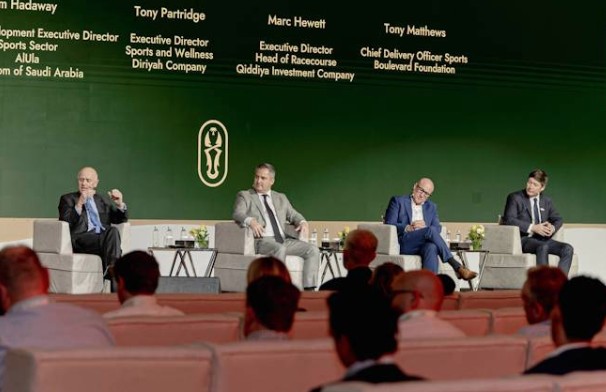
Riyadh – Leaders of Vision 2030 projects in various regions of the Kingdom of Saudi Arabia, during their participation in the 41st Asian Horse Racing Conference, affirmed that equestrianism and other sports play a pivotal role in supporting comprehensive economic development and promoting investment in the Kingdom.
The sports sector is a cornerstone of the Kingdom’s Vision, supported by significant investments in golf, tennis, and football. However, the deep passion for horse racing has made it a key driver of several rapidly growing projects across the Kingdom.
This topic was discussed during a panel discussion as part of the conference in Riyadh, organized by the Asian Federation of Horse Racing and hosted by the Jockey Club.
This coincided with the announcement of the establishment of a new equestrian center in Qiddiya outside the capital, reflecting the established status of horses in Saudi society and their important role in driving economic development.
Tim Hadaway, Executive Director of Equestrian Development in the sports sector in Al-Ula, explained that horses are at the heart of the strategic directions of the site, which will host one of the world championships later this year under the supervision of the International Equestrian Federation.
He said:
“Horses represent one of the main strategic pillars of the project, and are an essential part of Vision 2030 to promote economic growth, diversify sources of income, develop the tourism sector, and showcase this part of the Kingdom to the world.”
For his part, Mark Hewitt, CEO and President of the Equestrian Field at Qiddiya Investment Company, announced plans to build the new field that will become the future home of the Saudi Cup.
He added:
“We are focused on consolidating economic stability, expanding opportunities, providing jobs, achieving sustainability, and developing infrastructure. We are also working on building new residential and social communities that will accommodate 500,000 people and provide 200,000 jobs in the tourism, hospitality, education, sports, and entertainment sectors.”